Free Printable Shower Chart for Kids
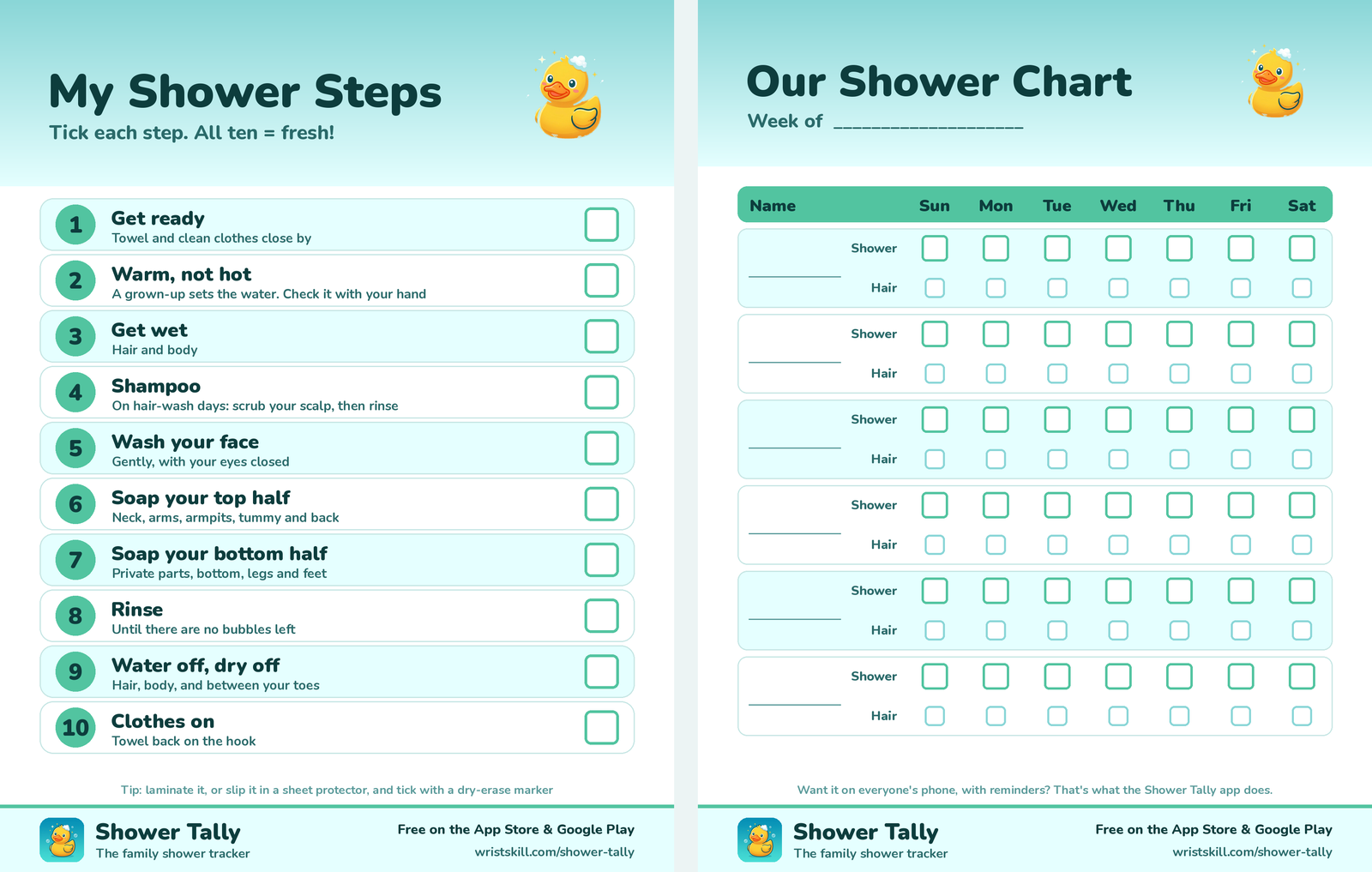
Two pages, free, no email needed. Page one is a ten-step shower routine your child ticks off as they go. Page two is a weekly chart for the whole household, with a shower row and a hair-wash row for each person. Below the download is how to teach the routine so the chart actually gets used.
What's in the PDF
Page 1: My Shower Steps
Ten short steps in the order most children need them: get ready, check the water, get wet, shampoo on hair-wash days, face, top half, bottom half, rinse, dry off, and clothes on. Each step has a big number, a one-line reminder, and a tick box sized for a dry-erase marker.
Page 2: Our Shower Chart
A Sunday-to-Saturday grid with room for six people. Each person gets a shower row and a smaller hair row, because hair washing usually runs on its own schedule. See how often kids should shower and wash their hair at each age for sensible numbers to aim for.
How to use the shower steps chart
Do it together first, then step back
Handing a child a checklist and leaving is the fastest way to get a chart that is ignored. For the first few showers, go through it with them. Name each step as it happens and point to it on the chart. As they get the hang of it, say less and point more, then move from beside them to the doorway, and eventually out of the room. The goal is that the chart does the reminding, not you.
Teach a few steps at a time
Occupational therapists often teach multistep routines by chaining: the child owns one step at a time while the adult does the rest, and the child's share grows. You can start from the first step and work forward, or start from the last step and work backward, so the child is always the one who finishes. A study comparing the two orders across children and tasks found neither was consistently faster, so choose whichever keeps your child succeeding. Many families like backward chaining for showers because every attempt ends with "I did it."
Make the steps match your bathroom
The chart is a starting point. Cross out steps that do not apply, write in ones that do, and change the wording to what you actually say at home. A bath-only household can swap the shower steps for bath steps. A child who is still building up to hair washing can skip step four until you add it back.
Keep an adult in charge of the water
Step two tells children that a grown-up sets the water, and that is deliberate. The American Academy of Pediatrics recommends setting your water heater so the hottest water at the tap is no more than 120°F (48.9°C). Checking the water with a hand is a good habit, but it is not a substitute for a safe maximum temperature. How much supervision a child needs in the bathroom is a separate decision, and it depends on the child far more than on any chart. Our readiness checklist for showering alone walks through it.
Keep showers short and warm
Long, hot showers dry the skin. The American Academy of Dermatology suggests keeping baths and showers to five to ten minutes in warm rather than hot water, which is also about as long as ten steps take once they are familiar.
Why a chart helps, and what the evidence actually says
It is worth being precise here. Visual schedules and step-by-step breakdowns are well studied in autism research. A review of twenty years of studies concluded that visual activity schedules can be considered an evidence-based practice for autistic people, especially when paired with systematic teaching. The National Clearinghouse on Autism Evidence and Practice's 2020 review also rates visual supports and task analysis as evidence-based practices, with self-help skills among the outcomes studied.
That evidence comes from autism and intellectual disability research, not from studies of typically developing children. For every other child the honest case is simpler: a routine written on the wall can be pointed at instead of repeated out loud, which takes a lot of the friction out of the nightly back-and-forth. For more on that, see how to get kids to shower without a fight, and if bathing is hard for sensory reasons, how to help an autistic child shower.
How to use the weekly chart
Put it where everyone passes it, not inside the bathroom where it gets wet. Write a name in each row, tick the shower row on the days each person showers, and tick the hair row on hair-wash days. After a week or two the pattern is obvious at a glance, and the "I did it yesterday" argument has an answer everybody can see.
A paper chart works best for one household in one place. It starts to strain when children move between two homes, when parents work different shifts, or when nobody remembers to redraw it on Sunday. At that point a shared record that everyone can see from their own phone does the same job without the fridge. That is what we built Shower Tally for.
FAQ
Is the shower chart really free?
Yes. The PDF downloads directly with no email and no account. The email signup on the page is optional and separate.
What age is the shower steps chart for?
It is written for children who are learning to shower with less help, which for many is early primary school, but readiness varies a great deal. Use it with an adult alongside at first, and keep an adult in charge of the water temperature.
Can I print it on A4 paper?
Yes. The PDF is US Letter size. Choose "fit to page" or "scale to fit" in your print settings and it prints cleanly on A4.
How do I stop it getting wet in the bathroom?
Laminate it or slide it into a clear sheet protector, then tick steps with a dry-erase marker so the same sheet lasts for weeks.
Why does the weekly chart have a separate row for hair washing?
Hair usually runs on a different schedule from bathing, and the right frequency changes with age and hair type, so it is easier to track on its own row than to fold into the shower tick.
Is there a picture version of the chart?
Not yet. This version uses short words and big numbers. Many families add their own photos of each step, which works well for children who do better with pictures than words.
Sources
- Knight, V., Sartini, E., & Spriggs, A. D. (2015). Evaluating visual activity schedules as evidence-based practice for individuals with autism spectrum disorders. Journal of Autism and Developmental Disorders, 45(1), 157–178.
- Steinbrenner, J. R., et al. (2020). Evidence-based practices for children, youth, and young adults with autism. FPG Child Development Institute, University of North Carolina, National Clearinghouse on Autism Evidence and Practice.
- Slocum, S. K., & Tiger, J. H. (2011). An assessment of the efficiency of and child preference for forward and backward chaining. Journal of Applied Behavior Analysis, 44(4), 793–805.
- American Academy of Pediatrics, HealthyChildren.org. Burn Treatment & Prevention Tips for Families.
- American Academy of Dermatology. Dermatologists' top tips for relieving dry skin.

The chart, on everyone's phone.
One shared board for the household: who showered, who is due, and hair washes tracked separately. Free to download.
Download on theApp Store Get it onGoogle Play